





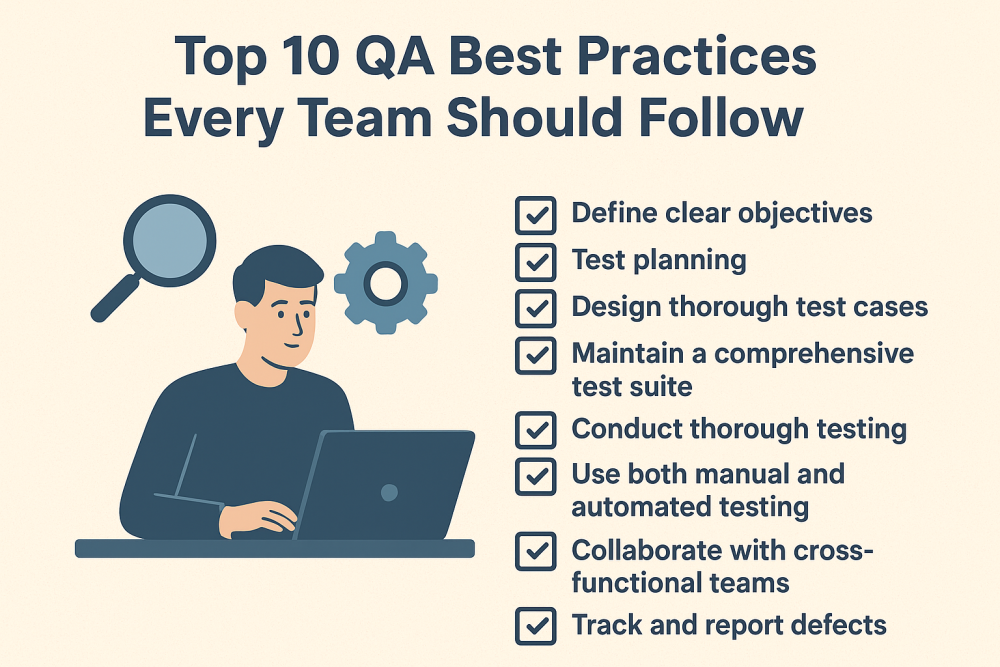
QA no longer comes as an afterthought before release; it's the foundation of solid, scalable, and customer-centric software. With user expectations at an all-time high and competition fiercer than ever, taking shortcuts on QA best practices is like constructing a house without checking for cracks in the foundation. Okay, it may hold up for a little while, but sooner or later, cracks appear. Adhering to tried-and-true QA best practices enables teams to consistently deliver high-quality software while shaving time, money, and pain in the future.
QA must start as soon as requirements are being discussed, not once coding is completed. This "shift-left" practice focuses on testing earlier in the development lifecycle, where defects are less expensive and simpler to correct. By engaging QA in design and planning activities, teams can identify ambiguities, make acceptance criteria clear, and avoid issues before they arise.
Example: Think of shift-left QA like inspecting blueprints before pouring concrete. You'd rather catch mistakes early than break down walls later.
Without a roadmap, QA efforts often become scattered and reactive. A strong QA strategy defines:
Testing goals and scope
Tools and frameworks to be used
Roles and responsibilities
Metrics for measuring success
This approach aligns QA with business goals. Rather than testing everything in a blind manner, teams target the areas that actually are important, be it performance, security, or usability.
Automation is a must-have in today's development cycles, particularly with CI/CD pipelines. Automated tests accelerate feedback loops, eliminate human bias, and enable testers to do exploratory testing.
But don't automate everything. Automate trivial, high-value tests such as unit, integration, and regression tests. Reserve usability, exploratory, and edge-case testing for manual test cases where human ingenuity comes in handy.
Pro tip: Adhere to the test automation pyramid unit tests at the bottom, middle with integration tests, and top with a small number of end-to-end UI tests.
You cannot test everything the same. Instead, focus on the highest risk first. Ask yourself:
What is most essential to the business? (e.g., payment stream, login)
Where will failure be most likely? (e.g., third-party API integrations)
What would hurt customer trust the most?
Risk-based testing guarantees QA time spent where it yields the most value, avoiding costly production defects.
Most defects are not code-related, but rather due to flaky test data or non-deterministic environments. QA teams must:
Utilize synthetic or masked production data for fidelity
Maintain environment parity with production (through Infrastructure-as-Code)
Reset test data between tests for determinism
Effective test data management prevents flaky tests and deceptive results, improving release confidence.
QA is not a gatekeeper, it's a team sport. The developers, testers, and product owners must cooperate early in the form of activities such as Three Amigos sessions (dev, QA, product). Such sessions bring forth clarity to requirements, minimize assumptions, and create tangible test scenarios.
Cooperation makes QA a blocker turned enabler, which makes the entire team its own quality.
Too many teams leave it at functional testing (does the software do what it's intended to?). But non-functional testing such as performance, security, accessibility, and usability is every bit as important.
Performance guarantees the app will perform under load.
Security keeps sensitive information safe.
Accessibility ensures software is accessible to all.
Usability decides customer satisfaction.
Omitting these is like building a racing car and not testing the brakes.
Contemporary software isn't "finished" when released it adapts. Shift-right testing involves observing actual user activity, executing canary releases, and even chaos testing on live systems. Features such as observability dashboards and real-user monitoring (RUM) provide worthwhile feedback loops, so teams can identify and fix problems before customers see them.
QA metrics drive improvement, but not all are created equal. Vanity measures such as "number of test cases run" hardly ever measure quality. Instead, concentrate on:
Escaped defects (production bugs)
Mean Time to Detect (MTTD) and Mean Time to Resolve (MTTR)
Defect density per release
Customer-visible SLAs and SLOs
These measures connect QA to business outcomes and bring teams back to value delivery.
Process and tools are helpful, but culture fuels real quality. Strong QA culture entails:
Developers author and are responsible for tests
Testers mentor, work alongside, and are champions of the user
Leadership emphasizes time for test and technical debt reduction
Quality is embedded in the team's DNA, not an afterthought
In these cultures, QA isn't a siloed department; it's integrated into each conversation, commit, and deployment.
QA best practices aren't checklists, they're habits that define how teams create software. By shifting left, automating intelligently, prioritizing risk, working across roles, and creating a culture of quality, teams can ship reliable, scalable, and user-friendly applications. The reward? Faster releases, happier customers, fewer midnight crises, and software you can be proud of.